.jpg)
Sunday, May 29, 2022
Friday, May 27, 2022
Spring at Longwood Gardens in Pennsylvania
.jpg)
Pierre S. du Pont was born in 1870 in a DuPont Company house overlooking the Brandywine Creek just north of Wilmington, Delaware. His early years were influenced by the area’s natural beauty & by the du Pont family’s long tradition of gardening. But not even Pierre himself could have predicted that he would someday become one of the country’s most influential gardeners.
While he always preferred to live amid the quiet, familiar beauty of the Brandywine Valley, Pierre was greatly influenced by his frequent travels around the globe. He attended several world’s fairs & expositions, where he was astounded by grand architecture & the latest technology, including the huge display of water pumps at the 1876 Centennial Exposition in Philadelphia & illuminated fountains at the 1893 World's Columbian Exposition in Chicago.
While traveling, he was also exposed to a wide variety of garden settings, including Horticultural Hall at the 1876 Centennial, England's Sydenham Crystal Palace, the Royal Botanic Gardens at Kew & the flora of South America, the Caribbean, Florida, California & Hawaii. Visits to Italian villas & French châteaux focused on the architectural qualities & water effects of those gardens.
In addition to his travels, Pierre also built an impressive record of success in corporate America. This success brought great wealth & he felt great responsibility to use it wisely. Pierre & his wife Alice gave generously to public schools, universities, & hospitals. But gardening remained his lifelong passion.
At the age of 36, Pierre bought the Peirce farm & soon began creating what would become Longwood Gardens. He followed no grand plan; rather, he built the gardens piecemeal, beginning with the “old-fashioned” Flower Garden Walk. His later gardens would draw heavily on Italian & French forms.
Many generations helped create Longwood Gardens, but Pierre du Pont – industrialist, conservationist, farmer, designer, impresario, & philanthropist – was to make the most enduring contribution.
When du Pont died in 1954, he left most of his estate to the Longwood Foundation to preserve & maintain & improve the gardens. Today, nearly 70 years after du Pont’s death, his gardens continue to delight & inspire visitors from around the world.. See: Longwood Gardens History for more.
“Beauty awakens the soul to act.” - Dante Alighieri (1265-1321)

Thursday, May 26, 2022
1595 Spring from The Four Seasons - Image after Hendrick Goltzius
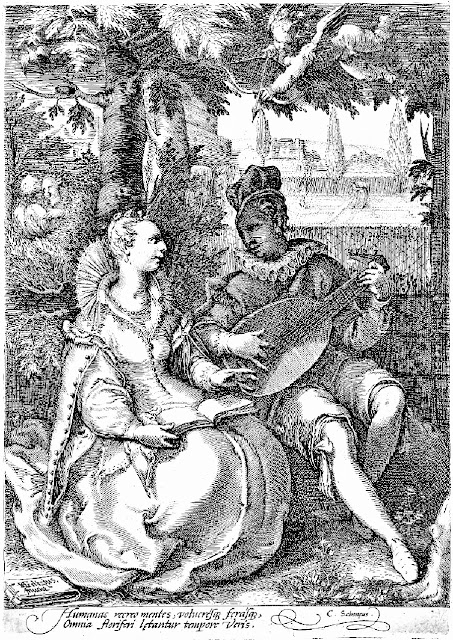
Spring - Four Seasons; Art after Hendrick Goltzius; print by Saenredam 1595
Wednesday, May 25, 2022
Spring at Longwood Gardens in Pennsylvania
.jpg)
There have been many stewards of the land that is now called Longwood Gardens. For centuries, the native Lenni Lenape tribe fished the streams, hunted its forests, & planted its fields. Evidence of tribe's existence is found in quartz spear points that have been discovered on & around the property.
In 1700, a Quaker farmer named George Peirce purchased 402 acres of this English-claimed land from William Penn’s commissioners. Over the next several years, George & his descendants cleared & farmed the rich land that would one day become Longwood Gardens. In 1730, one of George’s sons, Joshua, built a brick farmhouse that, now enlarged, still stands today.
Known as Peirce’s Park, the land became a popular destination for visitors. However, due to declining interest by the family, the trees came under threat of being cut down by a local lumber company. Pierre du Pont stepped in & bought the land to preserve it.
In 1798, George’s twin great-grandsons, Samuel & Joshua, actively pursued an interest in natural history & began planting an arboretum that eventually covered 15 acres. The collection included specimens from up & down the Eastern seaboard & beyond. By 1850, the land had become one of the best collections of trees in the country. The arboretum boasted one of the finest collections of trees in the nation & had become a place for the locals to gather outdoors – a new concept that was sweeping America at the time. Family reunions & picnics were held at Peirce's Park in the mid to late 19C.
As the 19C US fought its way to the 20C, the heirs to the land lost interest in property & allowed the arboretum to deteriorate. The property passed through several hands in quick succession, until a lumber mill operator was contracted to remove the trees from a 41-acre parcel within the original lands in early 1906.
It was this threat that moved one man to take action. In July 1906, 36-year-old Pierre du Pont purchased the farm primarily to preserve the trees. But he didn’t stop there. Much of what guests see today – the beauty & majesty & magic of the Earth that is Longwood Gardens – was shaped by the remarkable vision & versatility of Pierre du Pont. See: Longwood Gardens History for more.
“Beauty awakens the soul to act.” - Dante Alighieri (1265-1321)
Monday, May 23, 2022
Spring at Longwood Gardens in Pennsylvania
.jpg)
By the mid-1930s, Longwood had grown from the original 202 acres to 926 due to Pierre’s purchase of 25 contiguous properties over the years. In addition to horticulture, agriculture had always been important at Longwood, which started out, after all, as a farm.
Longwood’s agricultural & horticultural operations slowed considerably during World War II. Many employees served in the Armed Forces, & a 72-bed emergency hospital was set up in rooms above the Ballroom just in case the community needed it. Pierre du Pont was a “gentlemen farmer” who sought to create a self-sustaining model farm that used the latest techniques & methods. In reality, the farm was more an expansive, expensive hobby than a business, but it did produce food for the du Ponts & their employees.
As early as 1914 with the formation of Longwood, Inc., Pierre was thinking about the eventual fate of the property after his death. In 1944, Mrs. du Pont died, & Pierre initially retreated to his apartment in Wilmington during weekdays, visiting Longwood only on weekends. But he was more concerned than ever about Longwood's future, particularly since he had no children but considered the Gardens part of the du Pont family legacy.
In 1913, the US government enacted personal income tax. In response, Pierre incorporated Longwood in 1914. He always tried to stay one step ahead of the IRS to keep his farm & gardens in the best possible tax situation, & in 1937 the Longwood Foundation was created to handle his charitable giving. Finally, in 1946, the government gave approval for the Foundation to operate Longwood Gardens as a public garden with tax-exempt status “for the sole use of the public for purposes of exhibition, instruction, education & enjoyment.” See: Longwood Gardens History for more.
“Beauty awakens the soul to act.” - Dante Alighieri (1265-1321)
Subscribe to:
Posts (Atom)