Monday, November 6, 2023

Native American - Green Corn Dance of Thanksgiving


1590 North American Atlantic Coast Natives by John White (c1540 – c1593). The village of Pomeiooc (Pomeiock) was a Native America settlement, designated on de Bry’s map of Virginia, Americae Pars Nunc Virginia Dicta, between today’s Wyesocking Bay & Lake Landing, North Carolina. John White designates the settlement as Pomeyoo.

Extracted from:  Myths of the Cherokee.  Nineteenth Annual Report of the Bureau  of American Ethnology. Washington Government Printing Office 1902  Recorded by James Mooney (1861-1921) was an American ethnographer who lived for several years among the Cherokee.

Thanksgiving

Among all vegetables the one which holds first place in the household economy and ceremonial observance of the tribe is selu, "corn," invoked in the sacred formulas under the name of Agawe'la, "The Old Woman," in allusion to its mythic origin from the blood of an old woman killed by her disobedient sons ("Kana'ti and Selu"). 

In former times the annual thanksgiving ceremony of the Green-corn dance, preliminary to eating the first new corn, was the most solemn tribal function, a propitiation and expiation for the sins of the past year, an amnesty for public criminals, and a prayer for happiness and prosperity for the year to come. 

Only those who had properly prepared themselves by prayer, fasting, purification were allowed to take part in this ceremony, and no one dared to taste the new corn until then. Seven ears from the last year's crop were always put carefully aside, in order to attract the corn until the new crop was ripened and it was time for the dance, when they were eaten with the rest. In eating the first new corn after the Green Corn dance, care was observed not to blow upon it to cool it, for fear of causing a wind storm to beat down the standing crop in the field.

Sunday, November 5, 2023

1598 Spanish Thanksgiving - at the Rio Grande in Texas

Don Juan De Oñate celebrates Thanksgiving in 1598 at modern day San Elizario, Texas

One of  the earliest, colonial Thanksgiving took place in 1598.  The English arrived later than the Hispanics, as the Anglo-Saxon settlers founded Jamestown in 1607 and Plymouth in 1620, and by these years it is claimed that more than four hundred thousand Spaniards were already living in America. When the pilgrims arrived in Massachusetts, the America to which they arrived had been considered for more than a century as part of Spain.

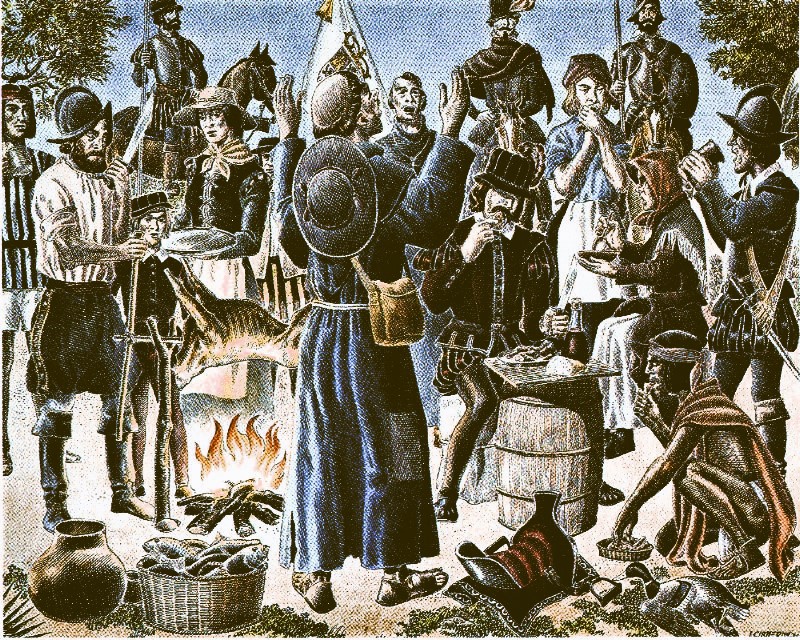
Conquistadors under the leadership of Don Juan De Oñate celebrated Thanksgiving in 1598 at modern day San Elizario, Texas.  Over 20 years before the widely known feast in New England, Spanish Conquistadors held a mass & a feast giving thanks in what is now San Elizario, Texas.  

Al Borrego, artist & spokesman for the San Elizario Genealogical & Historical Society, said "Oñate, colonizer of New Mexico, entered what is now the United States, near San Elizario, Texas, on April 20, 1598, at the banks of the Rio Bravo," Borrego said.  "They built a church with a nave large enough to hold the expedition (over 500), held a mass followed by the 'Toma' (official taking possession of the territory the river drained into), followed by a feast & celebration & even a comedy in the afternoon." 

The San Elizario celebration had all the key trappings of a Thanksgiving, right down to the local indigenous population joining in the meal.  Juan de Oñate was a member of a distinguished family that had loyally worked for the Spanish crown. His father had discovered & developed rich mines in Zacatecas, Mexico. Oñate, himself, had opened the mines of San Luis Potosí & performed many other services for the Spanish king. But he wanted to carve an unquestioned place in history by leading an important expedition into unexplored land.

He was granted land in the northern Rio Grande Valley among the Pueblo Indians by the viceroy of New Spain. The viceroy moved to a new post, however, & his successor was slow to grant Oñate permission to begin his expedition. Finally, in 1597, approval came. To reach his new holdings, Oñate chose to bypass the traditional route that followed the Rio Conchos in present-day Mexico to the Rio Grande & then northward along the Rio Grande into New Mexico.

In the summer of 1597, Oñate sent Vicente de Zaldívar to blaze a wagon trail from Santa Barbara in southern Chihuahua, along which could be found adequate water supplies. Zaldívar underwent many hardships, including capture by Indians, in carrying out his instructions. No mention of the hardships was made, however, when he made his report to Oñate. (The trail blazed by Zaldívar has become the route of today's highway between Chihuahua City & El Paso.)

By early March 1598, Oñate's expedition of 500 people, including soldiers, colonists, wives & children & 7,000 head of livestock, was ready to cross the treacherous Chihuahuan Desert. Almost from the beginning of the 50-day march, nature challenged the Spaniards. First, seven consecutive days of rain made travel miserable. Then the hardship was reversed, & the travelers suffered greatly from the dry weather. On one occasion, a chance rain shower saved the parched colonists. Finally, for the last five days of the march before reaching the Rio Grande, the expedition ran out of both food & water, forcing the men, women & children to seek roots & other scarce desert vegetation to eat. Both animals & humans almost went mad with thirst before the party reached water. Two horses drank until their stomachs burst, & two others drowned in the river in their haste to consume as much water as possible.  The Rio Grande was the salvation of the expedition, however. After recuperating for 10 days, Oñate ordered a day of thanksgiving for the survival of the expedition. Included in the event was a feast, supplied with game by the Spaniards & with fish by the natives of the region. A mass was said by the Franciscan missionaries traveling with the expedition. And finally, Oñate read La Toma -- the taking -- declaring the land drained by the Great River to be the possession of King Philip II of Spain.  A member of the expedition wrote of the original celebration, "We built a great bonfire & roasted the meat & fish, & then all sat down to a repast the like of which we had never enjoyed before. . .We were happy that our trials were over; as happy as were the passengers in the Ark when they saw the dove returning with the olive branch in his beak, bringing tidings that the deluge had subsided."

After the celebration, the Oñate expedition continued up the Rio Grande & eventually settled near Santa Fé. As one historian noted, when Jamestown & Plymouth were established early in the 17th century, they were English attempts to gain a foothold in the New World. Santa Fé was but one of hundreds of towns the Spanish already had established in the New World.

Adapted from an article by Mike Kingston, then editor of the Texas Almanac 1990–1991.

Saturday, November 4, 2023

1578 Thanksgiving in The Americas - Newfoundland

Sir Martin Frobisher, English mariner, privateer, explorer (born c 1535-1594)

In 1578, English explorer Martin Frobisher landed in what is now Newfoundland & Labrador, Canada, as part of his quest to locate the fabled Northwest Passage. Before the Europeans arrive, First Nations across Turtle Island had traditions of thanksgiving for surviving winter & for receiving crops & game as a reward for their hard work. These traditions appear to include feasting, prayer, dance, potlatch, & other ceremonies, depending on the native peoples giving thanks.

In response to his safe travels to the Great White North, over 4 decades before the Plymouth Colony celebration, Frobisher & his men held a service of thanks. "Frobisher, an English explorer in the uncharted northern territories, organized the 1st religious Thanksgiving for his crew & early Canadian settlers as a way to take stock of all they had accomplished in a short time." 

During his 1578 voyage to Baffin Island to set up a new English colony, Frobisher's ships were scattered. At Frobisher Bay, the explorer was happily reunited with his fleet, & all who had survived the storms honored their reunion with a day of thanks.

Martin Frobisher, mariner, explorer, 3 three voyages from England to the “New World” in search of a passage to Asia. He failed, but he was the 1st European to discover the bay that is named for him & returned with tons of dirt that he thought contained gold. Each expedition was bigger than the preceding one & on his 3rd, in 1578, he commanded a flotilla of 15 ships & more than 400 men. They set sail on 31 May for Baffin Island, where they intended to establish a gold mining operation & the 1st English colony in North America. On 1 July, they sighted Resolution Island, but they were driven by storms across the entrance to Hudson Strait. The fleet was dispersed & one ship, which carried their prefabricated barracks, was sunk by ice. Another ship deserted the flotilla & sailed back to England. 

The remaining ships assembled at the Countess of Warwick’s Island, which is known today as Kodlunarn Island, a tiny speck of land in Frobisher Bay. They established 2 mines on the island & set up shops to test the ore from other mines. The mine sites & the ruins of a stone house are still clearly visible.  

Vicious storms blew the fleet around Hudson Strait for most of July & when they finally assembled at their anchorage in Frobisher Bay, they celebrated Communion & formally expressed their thanks through the ship’s Chaplain, Robert Wolfall, who “made unto them a godly sermon, exhorting them especially to be thankefull to God for theyr strange & miraculous deliverance in those so dangerous places” (Richard Collinson, The Three Voyages of Martin Frobisher: In Search of a Passage to Cathaia & India by the North-West, Cambridge University Press, 2010).

Frobisher sailed for Elizabeth I, whose reign was marked by public acts of giving thanks. Elizabeth expressed her gratitude for having lived to ascend the throne, for delivery from the Spanish Armada and, in her last speech to Parliament, for her subjects.  

The 1st known use of the word “Thanksgiving” in English text was in a translation of the bible in 1533, which was intended as an act of giving thanks to God. The tradition of gratitude was continued each fall as people gave thanks for the harvest that would see them through the winter.

Forty-eight years later on November 14, 1606, inhabitants of New France under Samuel de Champlain held huge feasts of thanksgiving between local Mi’kmaq & the French. Though not known at the time by the settlers, cranberries, rich in vitamin C, are credited with helping avoid scurvy. The neighbouring Mi’kmaq likely introduced the French to cranberries, or as they called them, petites pommes rouges (little red apples).

Champlain’s feasts were more than an annual affair. To prevent the scurvy epidemic that had decimated the settlement at Île Sainte-Croix in past winters, the Ordre de Bon Temps (Order of Good Cheer) was founded, offering festive meals every few weeks. Medical treatises recommended better nutrition (more food) & entertainment to combat scurvy.

However, despite this history of uniquely Canadian thanksgivings, modern concepts of Thanksgiving were influenced by the American neighbors to the South. Foods that are associated with a “traditional” Thanksgiving, such as North American turkey, squash, & pumpkin, were introduced to citizens of Halifax in the 1750s by the United Empire Loyalists, who continued to spread this “traditional” fare to other parts of the country.

See
Bicheno, Hugh. Elizabeth's Sea Dogs. Conway, 2014.
Brigden, Susan. The Penguin History of Britain. Penguin, 2001.
Courtauld, Augustine. From the Ends of the Earth: An Anthology of Polar Writings. Oxford University Press, 1958
Elton, G.R. England Under the Tudors. Routledge, 2018.
Ferriby, David. The Tudors. Hodder Education, 2015.
Guy, John. Tudor England. Oxford University Press, 1988.
Wagner, John A. Historical Dictionary of the Elizabethan World. Greenwood, 1999.
Williams, Neville. The sea dogs. Weidenfeld and Nicolson, 1975.

Friday, November 3, 2023

1565 Spanish Thanksgiving in St Augustine

Bry Theodor De Bry (528-1598), The Natives of Florida Worshiping the Column Erected by the Commander on his First Voyage 1564

There are actually several events claiming to be the 1st Thanksgiving in colonial Spanish & English America. One of  the earliest, colonial Thanksgiving took place on September 8, 1565.  The English arrived later than the Hispanics, as the Anglo-Saxon settlers founded Jamestown in 1607 and Plymouth in 1620, and by these years it is claimed that more than 400,000 Spaniards were already living in America. When the pilgrims arrived in Massachusetts, the America to which they arrived had been considered for more than a century as part of the Crown of Castile.

An explorer, Pedro Menéndez de Avilé, along with 800 Spanish settlers celebrated a Mass of Thanksgiving to commemorate the successful sea voyage & founding of the town of St. Augustine, which would go on to be the 1st & longest-lasting port within the present-day United States. St. Augustine is the oldest continuously inhabited European-established settlement on  the Atlantic Coast of the United States.  

Occurring as it did so soon after trans-Atlantic landfall, this was a maritime Thanksgiving, with sailor's fare making up the bulk of the feast, probably along with local native food, which would likely have included oysters & fish. 

It is said he invited members of the Timucua tribe to dine along with them. The local St. Augustine Timucua were known by the Spanish as the "Agua Salada," or Salt Water, Timucua, a testament to the maritime culture that existed in St. Augustine prior to European colonization. 

This 1st Spanish Thanksgiving took place 55 years before the Pilgrims landed.  Following the sacrifice of the Holy Mass, Menindez ordered a communal meal to be shared by the Spaniards & the Indians who originally occupied the landing site.

Pedro Menéndez de Avilés (1519-1574) was a Spanish admiral, explorer & conquistador from Avilés, in Asturias, Spain. He is notable for planning the 1st regular trans-oceanic convoys, which became known as the Spanish treasure fleet, & for founding St. Augustine, Florida, c 1565.

Thursday, November 2, 2023

Egypt - Ancient Thanksgiving Celebrations - Harvest Festivals


The origins of Thanksgiving celebrations stem from the Harvest Festivals existing thousands of years before European colonists sailed for the Americas. Harvest festivals flourished, when hunger was a constant threat, & many societies often felt at the mercy of the gods. The Neolithic Agricultural Revolution resulted in the wide-scale transition of many human cultures & communities beginning 10-12,000 years ago as "hunter gatherers" began to settle down & farm. Their more permanent communities permitted humans to experiment with plants. Once early farmers invented agricultural techniques like irrigation, crops could yield surpluses that often needed storage. 

Most who earlier peoples who had foraged for their food could not easily store food for long due to their migratory lifestyle, whereas those with sedentary dwellings & fields carved in the landscape could grow & store their surplus grain. With this more reliable supply of food, populations could expanded & began to develop specialized workers & more advanced tools. This evolving knowledge led to the domestication of both plants & animals. 

A successful harvest was vital for the healthy stability of a community. Prior to the establishment of formal religions, some believed that their crops were controlled by gods or contained spirits. Harvest celebrations often marked the end of summer & were a time of feasting & paying tribute to gods for bounty, prosperity, & good health. These harvest festivals were common around the globe in one form or another for millennia. Some harvest festivals, more commercial than sacred, continue today.

Egypt's Harvest Festival of Min - The Feast of Dais

In Egypt, Min was a central god of reproduction & vegetation, & the Feast of the Dais was held in his honor.  Min was the Egyptian god of fertility, rain, the desert, & travelers. He was also considered a god of regeneration which is believed to symbolize the forceful renewal of the sovereignty of the Egyptian pharaoh. Min was honored in the coronation rites of new pharaohs to ensure their production of a male heir. Min was depicted as a human male with one arm, one leg & a prominent penis. He carried a flail & wore the Double Plumed Crown. 

The harvest festival to Min was an important celebration attended by the reigning pharaoh & the royal court. The pharaoh sitting on a canopied litter, his court, soldiers, standard bearers, fan bearers, dancers, musicians would form a great procession to his temple. The priests of Min also formed a large contingent in the procession, burning incense & carrying shrines & images of the pharaoh & his ancestors.  Elaborate floats formed part of the procession. At the front pf the procession was a white bull, the symbol of Min, that had a sun-disk fastened between his horns representing Min himself. 

During the Feast of the Dais, Min received the 1st wheat of the harvest cut by the pharaoh himself.  Pharaoh cut the first sheaf with a sickle & put it in front of the statue of God.  Min's holiday was celebrated at the beginning of the farming season, when Pharaoh hoeing a field with a hoe & poured water under the personal supervision of the god Min. When Pharaoh came to reign, he was also considered the heir of Min. During the festivals dedicated to Min, men participated in contests, games dedicated to God, such as climbing a high pole, probably from a tent.  Bouquets of flowers & the lettuce were also offered to Min. The relief above, from the funerary temple of Ramses III  at Medinet Habu, shows the harvest festival of Min featuring a statue of Min, which formed a major part of the procession, behind the carnival float of Min.  

The above relief of the procession float of Min depicts it followed by 2 priests. The priests carry sacred lettuce plants, the symbol of Min & similar in shape to Romaine lettuce. The pointed lettuce plants are stylized & frequently appear in many images depicting Min. The wild prickly lettuce Lactuca virosa was domesticated & this version of the lettuce was Lactuca sativa which was said to have both aphrodisiac & opiate qualities.

The cult of Min lasted for 3000 years & following the Roman conquest of Egypt even the Roman Emperor Augustus was depicted offering lettuces to Min god in the temple of Kalabsha, aka the Temple of Mandulis, that was located approximately 50 km south of Aswan.